Trapezoid: Definition, Properties, Types, Formulas, and Real-World Uses
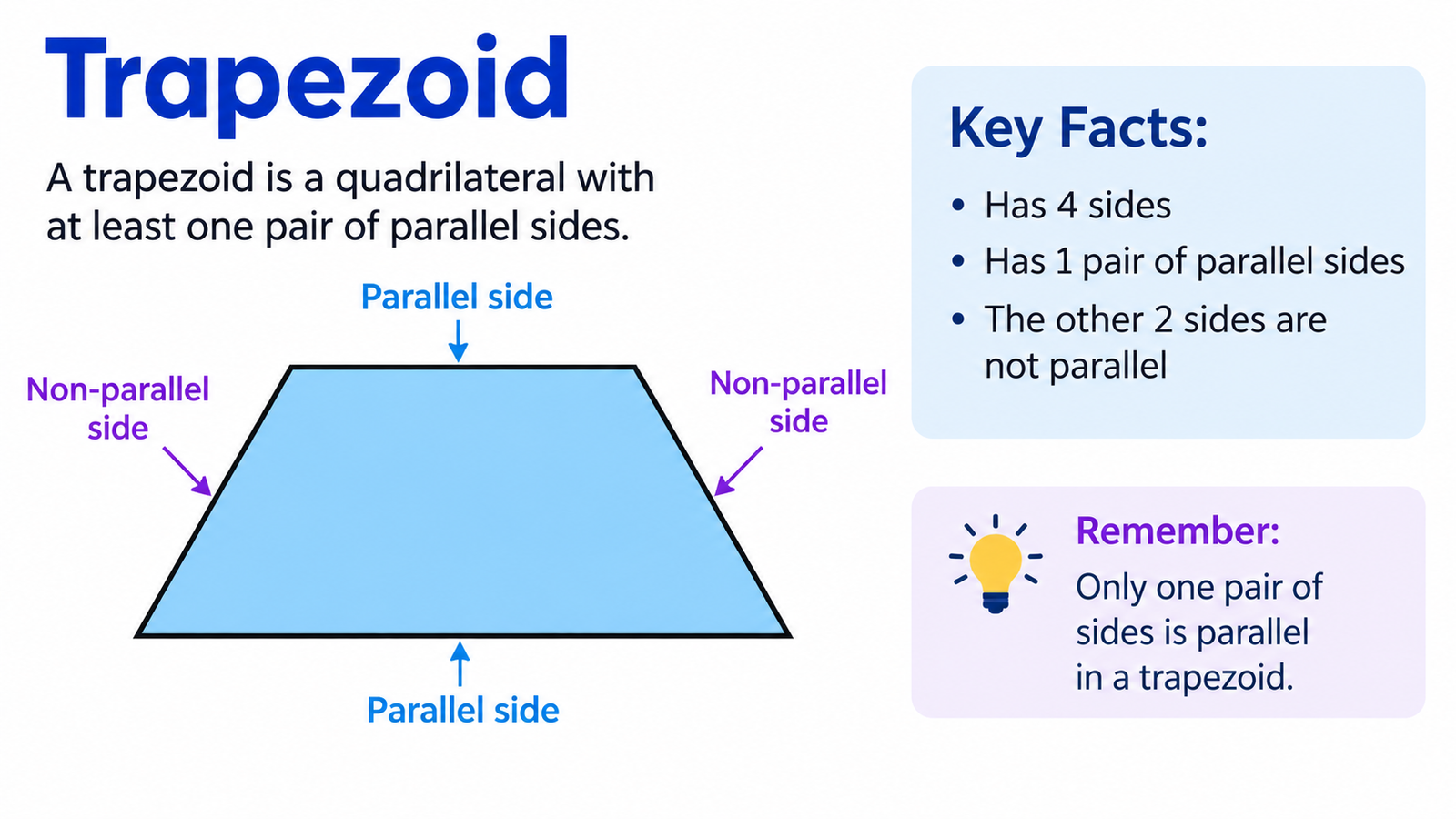
A trapezoid is a four-sided geometric shape with a pair of parallel sides. It appears in mathematics, architecture, engineering, design, and many everyday objects. Although its basic definition is simple, trapezoids have several properties and formulas that make them an important part of geometry.
Understanding a trapezoid becomes easier when you know how its sides, angles, height, diagonals, and area are connected. Different types of trapezoids also have their own characteristics. Some have equal non-parallel sides, while others contain right angles or have no special symmetry.
This guide explains what a trapezoid is, how to identify one, its main properties, different types, important formulas, and practical examples.
What Is a Trapezoid?
A trapezoid is a quadrilateral, which means it has four sides, four vertices, and four interior angles. Its defining feature is that it has at least one pair of parallel sides. The parallel sides are commonly called the bases of the trapezoid.
The two bases can have different lengths. Usually, the longer base is referred to as the larger base, while the shorter one is called the smaller base. The remaining two sides are known as the legs. The legs do not have to be parallel.
For example, imagine a four-sided figure with a horizontal top side and a longer horizontal bottom side. If these two sides never meet because they run in the same direction, they form the parallel bases of a trapezoid. The other two sides connect their endpoints.
The word trapezoid can have slightly different definitions depending on the mathematical convention being used. In some regions, a trapezoid is defined as a quadrilateral with at least one pair of parallel sides. In other conventions, the definition requires exactly one pair of parallel sides. This distinction is useful when studying different geometry textbooks or educational systems.
Main Parts of a Trapezoid
Knowing the names of the different parts makes trapezoid problems much easier to understand. A standard trapezoid contains two bases, two legs, four angles, and a height.
The bases are the parallel sides. They are often represented by letters such as and . The legs are the non-parallel sides and may have equal or unequal lengths depending on the type of trapezoid.
The height is the perpendicular distance between the two bases. It is important to remember that the height is not necessarily the same as the length of either leg. If a leg is slanted, its length will usually be greater than the vertical height.
The trapezoid also has four interior angles. Since every quadrilateral has an interior angle sum of 360 degrees, the four angles of a trapezoid always add up to 360 degrees.
Properties of a Trapezoid
Trapezoids have several useful geometric properties. The most important one is the presence of parallel bases.
When two parallel lines are crossed by another line, the interior angles on the same side of that crossing line are supplementary. As a result, the angles along each leg of a trapezoid add up to 180 degrees.
For a trapezoid with bases and , if is parallel to , then the pairs of angles connected by each leg have a combined measure of 180 degrees. This relationship can help solve missing-angle problems.
Another important property involves the area. The area depends on the lengths of the two parallel bases and the perpendicular height. The legs themselves do not appear directly in the basic area formula.
Trapezoids can also contain diagonals. A diagonal connects two opposite vertices. Every trapezoid has two diagonals, and their properties depend on the specific type of trapezoid.
Types of Trapezoids
Not every trapezoid looks the same. Geometry commonly discusses several special forms, including the isosceles trapezoid, right trapezoid, and general trapezoid.
An isosceles trapezoid has equal non-parallel sides. Its base angles are also equal in pairs, giving the shape a symmetrical appearance. This type is frequently used in geometry problems involving angles, diagonals, and symmetry.
A right trapezoid contains at least two right angles. One of its legs is perpendicular to the parallel bases. This makes the height easier to identify because the perpendicular leg can serve as the height.
A general trapezoid does not necessarily have equal legs, right angles, or symmetry. Its two bases may have different lengths, and its legs can have different lengths and slopes.
Understanding the type of trapezoid can make a problem much easier because special properties may provide additional information.
Trapezoid Area Formula
The area of a trapezoid can be calculated using a straightforward formula:
Area = ½ × (sum of the bases) × height
Using and for the two bases and for the height, the formula becomes:
A = ½(a + b)h
The height must be the perpendicular distance between the parallel bases. Using the length of a slanted leg instead of the height can produce an incorrect answer.
For example, suppose a trapezoid has bases measuring 10 centimeters and 16 centimeters, while its height is 5 centimeters. The calculation is:
A = ½(10 + 16) × 5
A = ½(26) × 5
A = 13 × 5
A = 65 square centimeters.
Therefore, the trapezoid has an area of 65 square centimeters.
How to Find the Height of a Trapezoid
Sometimes the height is given directly in a geometry problem. In other cases, you may need to calculate it from other measurements.
If the trapezoid is a right trapezoid, the perpendicular leg generally gives you the height immediately. For a slanted trapezoid, you may need to construct a perpendicular line from one base to the other.
Some problems provide enough information to use the Pythagorean theorem. For instance, if a slanted leg and a horizontal difference between the bases are known, the height can sometimes be found by treating part of the trapezoid as a right triangle.
The key idea is simple: height always means perpendicular distance between the bases. This definition remains true regardless of how the trapezoid is positioned on the page.
Perimeter of a Trapezoid
Finding the perimeter is even simpler than finding the area. Since the perimeter is the total distance around a shape, you add all four side lengths.
The general formula is:
P = a + b + c + d
Here, and can represent the parallel bases, while and represent the legs.
For example, if a trapezoid has side lengths of 8, 14, 6, and 7 centimeters, its perimeter is:
P = 8 + 14 + 6 + 7
P = 35 centimeters.
Unlike area, perimeter is measured in ordinary units such as centimeters, meters, inches, or feet rather than square units.
Angles in a Trapezoid
The four interior angles of every quadrilateral add up to 360 degrees. Therefore, a trapezoid also has an interior angle sum of 360 degrees.
Because the bases are parallel, consecutive interior angles along a leg are supplementary. That means their measures add to 180 degrees.
For example, if one angle next to a leg measures 70 degrees, the adjacent angle connected through the same leg measures 110 degrees.
Special trapezoids can make angle calculations even easier. In an isosceles trapezoid, the angles associated with the same base are equal. This creates additional relationships that can be used to solve unknown angles.
Diagonals of a Trapezoid
A diagonal is a line segment connecting opposite vertices. Every trapezoid has two diagonals.
In a general trapezoid, the diagonals do not necessarily have the same length. Their relationship depends on the dimensions and shape of the figure.
An isosceles trapezoid has an important special property: its diagonals are equal in length. This is one reason isosceles trapezoids are useful in geometry problems involving symmetry.
Diagonals can also help divide a trapezoid into triangles. Since the area of a triangle is easier to calculate in many situations, dividing a trapezoid into triangles can provide another way to understand or solve certain geometry problems.
Isosceles Trapezoid and Its Special Features
An isosceles trapezoid has two equal legs. This creates a balanced shape in which the non-parallel sides mirror one another.
One of its most recognizable properties is its symmetry. When positioned normally, an isosceles trapezoid has a line of symmetry passing through the middle of its bases.
The base angles are equal in pairs. For example, the two angles next to the larger base have the same measure, while the two angles next to the smaller base also match each other. The diagonals are equal as well.
These properties make an isosceles trapezoid particularly useful when solving problems where only a few measurements are provided.
Right Trapezoid and Its Features
A right trapezoid is a trapezoid containing right angles. Since two right angles are supplementary, they commonly occur along the same perpendicular leg.
The perpendicular leg can represent the height of the trapezoid. This makes area calculations particularly direct because the height is already visible as one of the sides.
Right trapezoids are useful in practical designs because straight vertical and horizontal edges are common in construction and manufacturing. Their geometry can also be connected to rectangles and right triangles.
When solving a right trapezoid problem, look first for the pair of parallel sides and then identify the side that is perpendicular to them.
Trapezoid vs. Other Quadrilaterals
A trapezoid belongs to the larger family of quadrilaterals. Other common quadrilaterals include rectangles, squares, parallelograms, rhombuses, and kites.
A rectangle has two pairs of parallel sides and four right angles. A square has the same parallel-side relationship but also has four equal sides.
A parallelogram has two pairs of parallel sides. Depending on the definition of trapezoid being used, a parallelogram may or may not be considered a trapezoid. Under the inclusive definition, it qualifies because it has at least one pair of parallel sides. Under the exclusive definition, it does not because it has two pairs.
This difference explains why definitions matter when discussing quadrilateral classifications.
Real-World Uses of Trapezoids
Trapezoidal shapes can be found in many areas outside classroom geometry. Architects and engineers use them when designing structures that require specific proportions, angles, or support arrangements.
Roads, bridges, building features, furniture components, and decorative designs can all contain trapezoidal elements. Some mechanical components also use trapezoidal profiles because they can provide useful combinations of width and stability.
Graphic designers may use trapezoids to create perspective effects. When a rectangular object is viewed from an angle, its projected shape can sometimes resemble a trapezoid.
The shape is also common in everyday objects. Tables, lampshades, containers, and architectural details may use trapezoidal outlines for functional or visual reasons.
How to Solve a Trapezoid Problem
The first step is to identify the parallel sides. These are the bases, and recognizing them helps determine which formula or property you need.
Next, check what information the problem provides. If you know both bases and the height, the area formula is usually the quickest approach. If all four sides are known, you can find the perimeter by adding them.
For angle problems, look for supplementary angle relationships along the legs. For an isosceles trapezoid, also look for equal base angles and equal diagonals.
Finally, make sure your units are consistent. If one measurement is in meters and another is in centimeters, convert them before calculating. This simple step can prevent many avoidable errors.
Final Thoughts on Trapezoids
A trapezoid is a versatile quadrilateral defined by its parallel bases. Once you understand its basic parts, the shape becomes much easier to work with. The most important concepts include the bases, legs, height, angles, perimeter, and area.
The area formula, A = ½(a + b)h, is especially useful because it works for trapezoids of many different shapes and sizes. Special forms such as isosceles and right trapezoids add useful properties that can simplify geometry problems.
Whether you are studying geometry, working on a mathematical exercise, or simply trying to understand shapes around you, learning the structure of a trapezoid provides a strong foundation for more advanced geometric concepts.