Grenfell Tower: The Story, Tragedy, Investigation, and Legacy
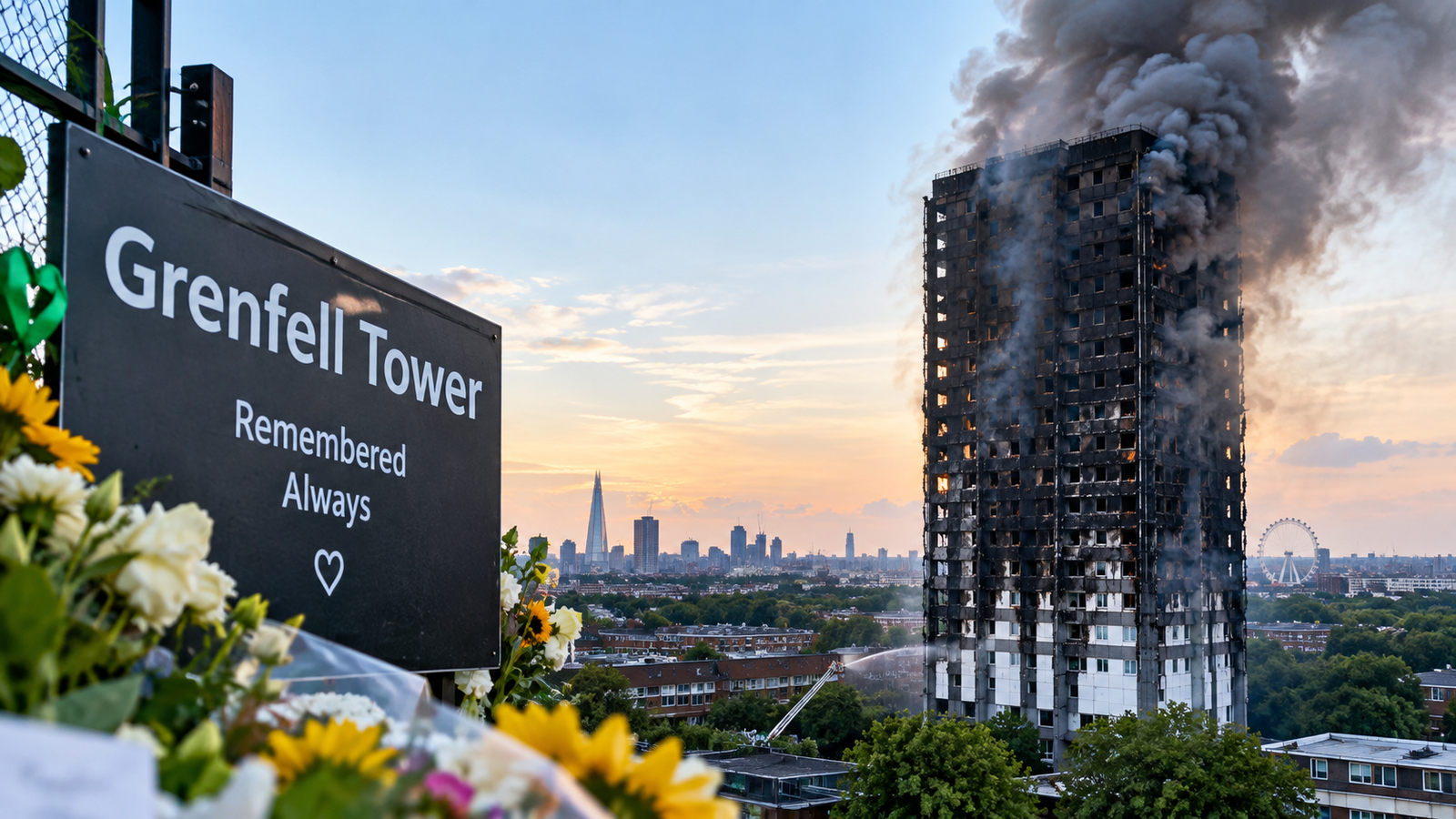
Grenfell Tower became one of the most widely discussed buildings in modern British history after a devastating fire struck the residential high-rise in west London on 14 June 2017. The tragedy resulted in 72 deaths and left many more people affected by the loss of family members, friends, homes, and a sense of security.
The building stood in North Kensington and had been part of the local community for decades. Before the fire, Grenfell Tower was primarily known as a residential building. After the disaster, its name became closely associated with questions about building safety, refurbishment decisions, fire regulations, accountability, and the experiences of residents.
The Grenfell Tower tragedy also changed the wider conversation about high-rise housing in the United Kingdom. Issues that might previously have received limited public attention became matters of national concern. Residents, campaigners, journalists, engineers, lawyers, and policymakers examined how the building had been designed, refurbished, managed, and maintained.
Understanding Grenfell Tower therefore requires more than looking at the night of the fire. It also involves examining the building’s history, the refurbishment, the spread of the fire, the emergency response, the public inquiry, and the changes that followed.
The History of Grenfell Tower
Grenfell Tower was completed in 1974 as part of a social housing development in North Kensington, London. The building was designed as a 24-storey residential block and formed part of the Lancaster West estate.
For many years, Grenfell Tower provided homes for people from different backgrounds. Like many social housing buildings, it was not simply a structure made from concrete, steel, and other materials. It was also a community where residents built relationships and lived their daily lives.
The tower contained residential flats along with communal areas. Over time, the building became an established part of the North Kensington landscape. Its location placed it close to affluent areas of west London, creating a striking contrast between different forms of housing and wealth within a relatively small geographical area.
That social context became an important part of discussions after the fire. Questions about housing quality, inequality, resident representation, and the treatment of social tenants became closely connected with the wider Grenfell story.
The Refurbishment of Grenfell Tower
Grenfell Tower underwent a major refurbishment before the fire. Work began in 2015 and was completed in 2016. The project included changes to the building’s external appearance and improvements intended to enhance its energy performance and appearance.
The refurbishment included the installation of an external cladding system. Materials used in the external wall construction later became a central issue in investigations into how the fire spread.
The purpose of a refurbishment project can involve many practical considerations, including insulation, weather protection, appearance, energy efficiency, and maintenance. However, the Grenfell disaster raised serious questions about how those considerations were balanced with fire safety.
The Grenfell Tower Inquiry examined the refurbishment process in extensive detail. It considered the roles of various companies and individuals involved in the design, manufacture, supply, installation, approval, and management of the building’s external wall system.
What Happened on 14 June 2017
The fire began during the early hours of 14 June 2017. According to the inquiry’s findings, the fire started in a fourth-floor flat after a refrigerator-freezer malfunctioned.
Initially, the fire was contained within the flat. It then reached the external wall system of the building. Once the flames entered the external wall construction, the fire spread rapidly up and across the outside of the tower.
The speed and scale of the fire created an extremely dangerous situation for residents. Smoke and flames affected different parts of the building, while people inside had to make decisions under extraordinary conditions.
Firefighters from the London Fire Brigade attended the scene and carried out rescue operations. Many emergency workers entered the building to try to help residents. The response involved a large number of firefighters and emergency personnel.
Why Did the Fire Spread So Quickly?
One of the central questions surrounding Grenfell Tower has been why a fire that started in a single flat was able to spread so extensively.
The Grenfell Tower Inquiry examined the external wall construction and concluded that the ACM panels with polyethylene cores were the principal reason for the rapid external fire spread. The inquiry also examined the role of insulation and other components within the wall system.
The interaction between different materials was important. The external wall was not a single product. It was a system made up of several components that had to work together in relation to fire safety.
The inquiry found serious failures involving the manufacture, marketing, testing, certification, and use of products associated with the refurbishment. These findings helped explain why the fire behaved differently from what residents and professionals might reasonably have expected from a modern high-rise building.
The Stay-Put Policy
Another major issue examined after the Grenfell fire was the building’s “stay put” strategy.
For many years, the general principle in purpose-built flats was that residents could remain inside their homes during a fire if the fire was confined to another flat. This approach was based on the assumption that compartmentation would prevent fire and smoke from spreading rapidly between separate homes.
At Grenfell Tower, however, the conditions changed dramatically once the external wall system became involved.
The inquiry examined how residents received advice during the fire and how information changed as the situation developed. The failure to revise the strategy quickly enough became an important part of the investigation into the disaster.
The Emergency Response
The London Fire Brigade’s response involved firefighters, fire engines, specialist equipment, and emergency coordination. Firefighters faced extremely difficult conditions inside the tower.
Some residents were rescued from their flats, while others escaped independently. The building’s height, smoke conditions, heat, communication difficulties, and rapidly changing circumstances created major challenges.
The emergency response has been examined extensively by the Grenfell Tower Inquiry. The inquiry considered not only individual actions but also wider issues involving training, procedures, communication, equipment, and preparedness for high-rise fires.
It is important to distinguish between the bravery of individual firefighters and the institutional questions raised about emergency planning. Many firefighters placed themselves in serious danger while attempting to save residents.
The 72 People Who Died
The Grenfell Tower fire killed 72 people. Their deaths remain the most painful part of the disaster.
The victims included children, adults, older people, families, and individuals living alone. They came from different backgrounds and had different personal stories, but they were connected by the community in which they lived.
Remembering the victims is central to discussions about Grenfell. The tragedy was not simply a failure involving a building or a regulatory system. It affected real families and permanently changed the lives of survivors and relatives.
Many survivors also experienced significant trauma. Some lost relatives, friends, neighbours, or their homes. Others had to deal with the physical and emotional consequences of escaping a major high-rise fire.
The Grenfell Tower Inquiry
The Grenfell Tower Inquiry was established to investigate the circumstances leading up to and surrounding the fire. Its work became one of the most detailed investigations into a building disaster in the United Kingdom.
The inquiry examined a wide range of evidence. This included documents, emails, technical information, witness testimony, corporate records, and evidence from residents and professionals.
The inquiry was divided into phases dealing with different aspects of the disaster. It examined the fire itself, the refurbishment, the regulatory environment, and the roles of organisations and individuals connected with the building.
The inquiry’s final report was published in September 2024. Its findings described serious and systemic failures across different parts of the construction and building safety system.
Findings About the Construction Industry
One significant part of the inquiry concerned the behaviour of companies involved in the construction and refurbishment process.
The inquiry identified serious failures relating to manufacturers, contractors, and other organisations. It found that some companies had engaged in practices that contributed to the use of unsafe products or the misunderstanding of their fire performance.
The findings demonstrated how complicated supply chains can create safety risks when responsibilities are unclear or when companies fail to communicate accurate information.
The Grenfell case also highlighted the importance of independent testing and reliable certification. A product’s safety cannot depend solely on assumptions, marketing claims, or incomplete information.
Building Regulations and Fire Safety
Grenfell Tower also became a major case study in the weaknesses of the building regulatory system.
Before the fire, building regulations and guidance relating to external walls, fire performance, and high-rise buildings were already complex. The inquiry examined how the regulatory framework functioned in practice and how different organisations interpreted technical guidance.
Following the disaster, the government introduced major changes to building safety legislation and regulation.
The Building Safety Act 2022 became a central part of the UK’s new building safety framework. It introduced new responsibilities and regulatory structures intended to improve accountability for higher-risk buildings.
The Impact on Other High-Rise Buildings
Grenfell did not remain an isolated event. After the fire, attention quickly turned to other high-rise buildings with similar cladding systems.
Testing and inspections were carried out across the country. Some buildings were found to have external wall materials or other safety issues that required remediation.
This created another major challenge. Removing unsafe cladding from high-rise buildings can be technically complicated and expensive. Residents and building owners faced uncertainty over who should pay and how quickly work could be completed.
The process of identifying and remediating unsafe buildings continued for years after the Grenfell fire.
The Human Impact on Survivors
For survivors, the Grenfell tragedy did not end when the flames were extinguished. Many people had to find temporary accommodation and rebuild their lives after losing their homes.
Relocation created additional difficulties. Moving away from the immediate area could separate residents from schools, workplaces, family members, friends, and familiar community networks.
The psychological impact was also significant. Survivors and bereaved families have spoken publicly about grief, trauma, anger, and the difficulty of returning to ordinary life after such an event.
The long-term effects demonstrate why disaster recovery cannot be measured simply by rebuilding a physical structure. Communities also require housing, support services, communication, and meaningful involvement in decisions affecting their future.
Grenfell Tower Today
Grenfell Tower remains standing, although the building has been covered since the fire and has not returned to residential use.
The future of the tower has been the subject of consultation and debate involving bereaved families, survivors, residents, and authorities. Decisions about the site carry enormous emotional significance because the building is both a physical structure and a symbol of the people who died there.
Any future treatment of the site therefore involves more than an architectural question. It involves memory, grief, community identity, and the wishes of people directly affected by the tragedy.
How Grenfell Changed Building Safety
The Grenfell disaster fundamentally changed the UK’s approach to building safety.
The tragedy helped drive reforms intended to create clearer responsibility for safety throughout the life of higher-risk buildings. The Building Safety Act introduced a new regulatory framework and established the Building Safety Regulator.
Fire safety rules and guidance have also been strengthened in various areas. The wider construction industry has faced increased scrutiny regarding materials, testing, certification, design, installation, and accountability.
The reforms are intended to reduce the possibility of another disaster of this kind. Their effectiveness will depend on how consistently the new requirements are implemented and enforced.
Why Grenfell Tower Still Matters
Grenfell Tower remains important because its story involves much more than one night in London. It raises questions about how buildings are designed, how safety information is communicated, how residents are heard, and how responsibility is distributed between organisations.
The disaster also demonstrates how technical decisions can have human consequences. A choice involving a construction material may appear distant from everyday life, but in a high-rise residential building, that decision can directly affect people’s safety.
The Grenfell story has therefore become part of a broader discussion about building safety and public accountability.
Remembering Grenfell
More than nine years after the fire, Grenfell continues to be remembered by survivors, bereaved families, local residents, firefighters, campaigners, and communities across the UK.
The annual anniversary provides an opportunity to remember the 72 people who died and to recognise the continuing experiences of survivors and bereaved relatives.
The tragedy has also become a reminder that safety systems must work in practice, not simply exist on paper. Regulations, inspections, construction standards, emergency procedures, and communication all need to function together.
Grenfell Tower’s history shows why these systems matter. Behind every technical document, building regulation, and construction decision are people whose lives depend on those systems working properly.
Conclusion
Grenfell Tower was a residential building that became the centre of one of the UK’s most significant public inquiries after the devastating fire of 14 June 2017. The deaths of 72 people exposed serious problems involving building materials, refurbishment, fire safety, regulation, communication, and accountability.
The Grenfell Tower Inquiry provided a detailed examination of how these failures developed and interacted. Its findings have influenced the UK’s approach to building safety and continue to shape discussions about responsibility within the construction and housing sectors.
The legacy of Grenfell is ultimately about people. The victims, survivors, families, residents, and emergency workers remain at the heart of the story. Remembering what happened also means understanding the failures that allowed the disaster to occur and ensuring that lessons from the tragedy remain part of future building safety practices.